
Keep your business connected with a network that can adapt to changing traffic, application demands, and connectivity conditions.
Gibson Teldata helps businesses design and deploy SD-WAN solutions that improve network performance, increase resiliency, and make multi-location connectivity easier to manage.
Prioritize critical applications and intelligently route traffic across available connections to help users get consistent performance where it matters most.
Reduce dependence on a single connection with automatic failover and multiple available network paths.
Get better visibility into network traffic, application performance, and connectivity across your locations.
Your network has to support more than it used to. Cloud applications, VoIP, video meetings, multiple locations, remote access, and growing bandwidth demands can put pressure on traditional WAN environments. When your network can’t adapt, your users often feel the effects first.
Stop dealing with:
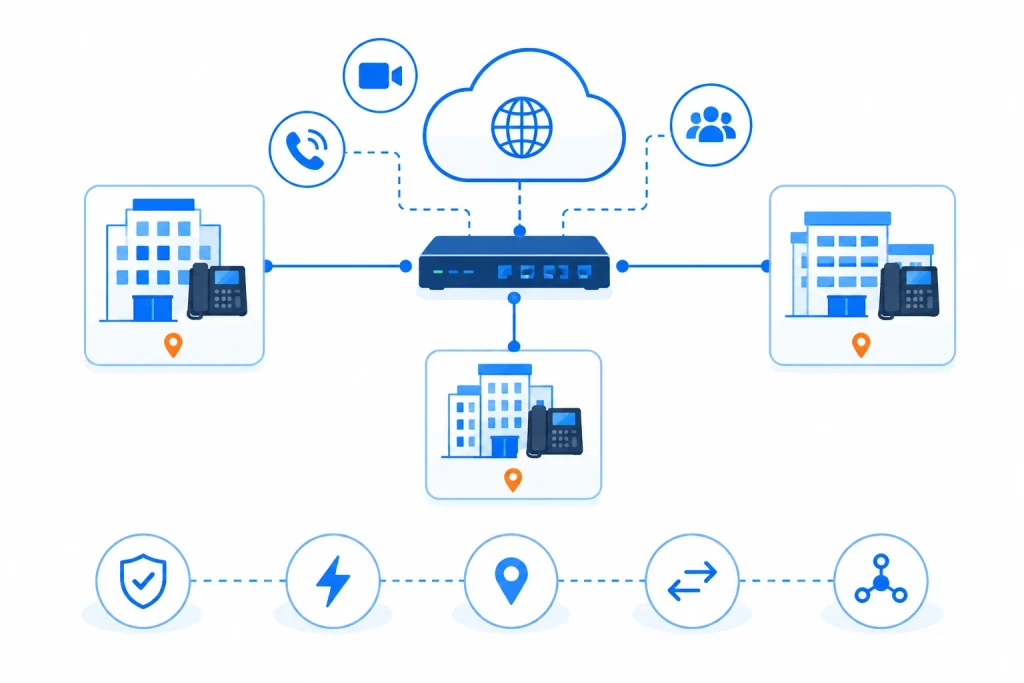
SD-WAN uses software-defined networking to manage traffic across multiple available connections. Instead of relying on one fixed path, the network can make routing decisions based on application needs, business policies, and current network conditions.
SD-WAN monitors the performance and availability of broadband, fiber, MPLS, and other network connections in real time.
SD-WAN recognizes the needs of different applications, including voice, video, cloud platforms, and other business-critical tools.
SD-WAN directs traffic over the best available path based on connection health, application needs, and business policies.
SD-WAN gives growing and multi-location organizations more flexibility without making the network harder to manage.
It’s especially useful when your business depends heavily on cloud services, real-time communications, or reliable connectivity between locations.
Prioritize business-critical applications such as voice, video conferencing, and cloud platforms so they aren't competing equally with less important network traffic.
Prioritize business-critical applications such as voice, video conferencing, and cloud platforms so they aren't competing equally with less important network traffic.
Prioritize business-critical applications such as voice, video conferencing, and cloud platforms so they aren't competing equally with less important network traffic.
SD-WAN gives businesses more control over how network resources are used while creating a more flexible foundation for locations, users, cloud applications, and communications.
Identify different types of application traffic and route them according to performance needs and business priorities.
Manage policies and gain visibility across multiple business locations through a more centralized network environment.
Keep traffic moving by shifting to another available connection when the primary network path becomes unavailable.
Identify different types of application traffic and route them according to performance needs and business priorities.
Manage policies and gain visibility across multiple business locations through a more centralized network environment.
We start with your locations, users, applications, bandwidth requirements, and business priorities before recommending an SD-WAN strategy.
Gibson can help evaluate your existing connections and determine how fiber, broadband, MPLS, and other services can work together.
Our team helps you plan, configure, and implement an SD-WAN environment designed around how your organization actually operates.
Your network needs will continue to change. Gibson provides ongoing support to help you adapt as locations, applications, and connectivity requirements evolve.
SD-WAN stands for software-defined wide area network. It uses software-based controls to manage traffic across different network connections. The technology can evaluate application requirements and network conditions, then direct traffic according to predefined policies.
Traditional WAN environments often rely on fixed network paths between locations. SD-WAN gives businesses more flexibility by allowing traffic to use different available connections according to application needs, network performance, and business rules.
It can, but it doesn’t have to. Some businesses use SD-WAN to replace MPLS, while others combine the two. The best approach depends on your existing infrastructure, locations, applications, performance needs, and connectivity requirements.
SD-WAN may be a good fit if your organization has multiple locations, relies heavily on cloud applications, needs greater network resiliency, or wants more control and visibility over network performance. Gibson can assess your current environment and help determine whether SD-WAN makes sense for your business.
Your network should make it easier for your business to communicate, connect, and grow. Talk with Gibson Teldata about your current connectivity challenges and we’ll help you determine the right technology strategy for your organization.