
The way businesses make and receive calls is changing. Gibson Teldata helps you connect your phone system to the right voice services, whether you’re modernizing legacy lines, moving to SIP, replacing aging analog connections, or making it easier for customers to reach you.
Send important notifications across multiple communication channels so employees, students, visitors, customers, and other groups can receive clear information wherever they are.
A mass notification system gives organizations a centralized way to quickly distribute important messages to large groups of people.
Depending on the solution, notifications can be delivered through multiple channels, including voice calls, text messages, email, mobile notifications, desktop alerts, digital signage, paging systems, and other connected devices.
Messages can also be targeted. Instead of notifying everyone about every situation, organizations can communicate with specific locations, departments, teams, or other defined groups.
Mass notification is commonly associated with emergencies, but it can also support severe weather updates, building closures, schedule changes, operational disruptions, and other situations where information needs to reach a lot of people quickly.

Mass notification benefits businesses that:
Need to communicate across multiple buildings or locations
Want to reach people through more than one communication channel
Have employees who work remotely, travel, or spend time away from desks
Need a consistent process for urgent and time-sensitive announcements
Operate schools, healthcare environments, campuses, manufacturing facilities, or other large organizations
Want paging, mobile communication, and other notification tools to work together
Gibson Teldata helps determine which communication channels, integrations, groups, and notification workflows make sense for your organization.
Capabilities vary by platform, but modern mass notification solutions include:
Distribute messages through supported channels such as voice, text, email, mobile devices, desktop alerts, paging, and digital signage.
Send information to the entire business or narrow notifications to specific locations, departments, teams, or other groups.
Prepare frequently needed messages ahead of time so authorized users can communicate quickly when situations arise.
Supported systems can allow recipients to acknowledge notifications, respond to prompts, or provide information back to the organization.
Connect mass notification with compatible paging, phone, access control, life safety, and other communication systems to extend the reach of important messages.
Give authorized teams a defined way to distribute time-sensitive information without manually contacting people one at a time.
Use multiple channels to communicate with people in the building, elsewhere on campus, working remotely, or on the go.
Send the same approved information across multiple channels so recipients aren't receiving conflicting updates.
Keep employees, leadership, emergency teams, students, visitors, or other groups informed as a situation develops.
No. While they’re valuable for emergency communication, organizations can also use them for severe weather, closures, schedule changes, operational disruptions, facility updates, and other time-sensitive information.
Yes. Depending on the system, messages can be delivered through channels like text, voice calls, email, mobile applications, and other connected platforms.
No. Modern systems can typically target specific groups, departments, facilities, locations, or other defined audiences.
Not necessarily. Mass notification can complement fire alarms and other life safety technology, but each system has its own role and applicable requirements. Gibson Teldata reviews your environment and helps determine how the different systems should work together.
Distribute background music and other audio throughout your facility with centralized controls that make it easier to manage what plays, where it plays, and how it works alongside paging.
Music distribution systems deliver background music or other audio sources to speakers throughout a business, facility, or campus.
Unlike a basic speaker setup, a professionally designed system can divide a property into separate audio zones, giving businesses greater control over volume, sources, and where audio is played.
Music distribution also works alongside paging systems. When an announcement needs to be made, supported systems can lower or temporarily interrupt background audio so the message comes through clearly before returning to regular programming.
From retail stores and waiting rooms to hospitality environments, offices, schools, and public spaces, audio distribution can help create a more consistent experience across your facility.
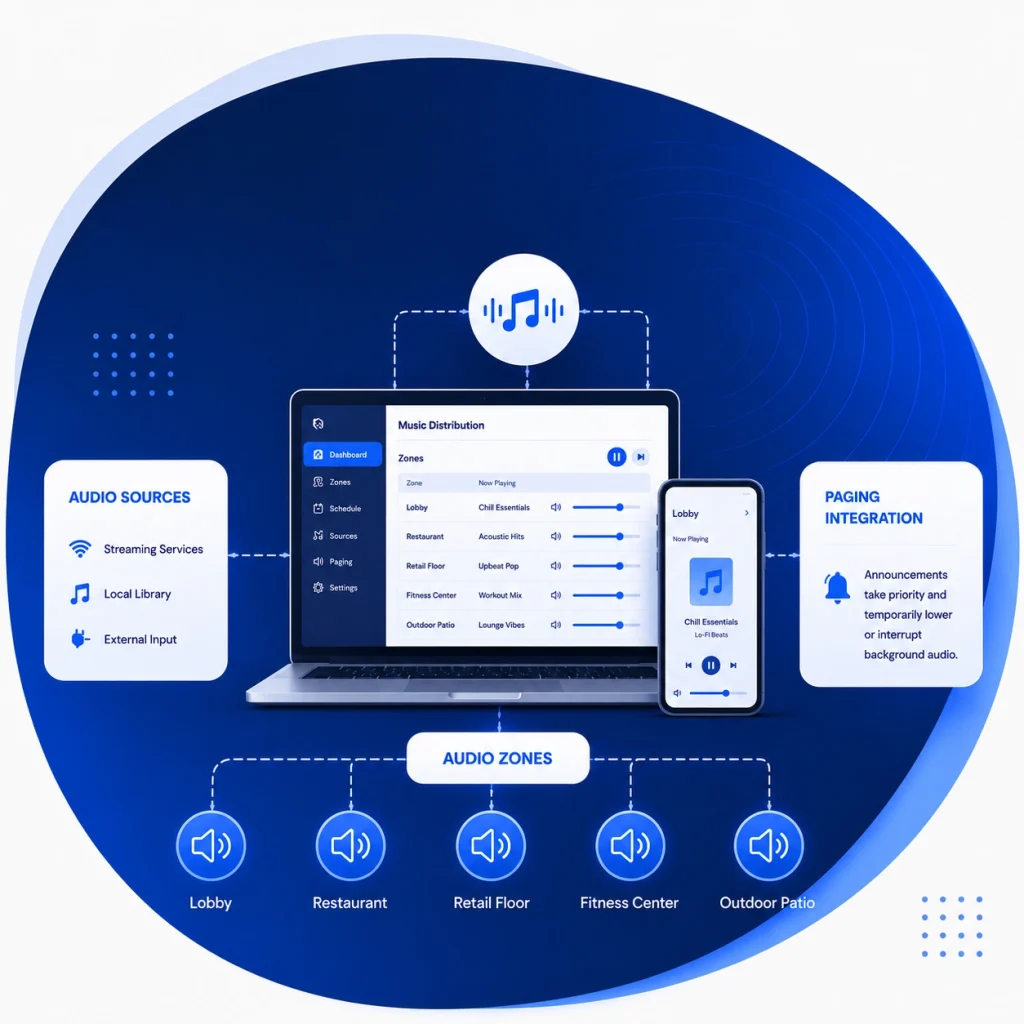
A music distribution system is a good fit if your business:
Uses background music in customer or employee spaces
Has different audio needs across different parts of a facility
Needs audio across multiple rooms, floors, or buildings
Wants background music to work alongside paging and announcements
Wants separate volume control for different areas
Needs a more professional alternative to individual speakers and disconnected audio devices
Gibson Teldata designs audio coverage around your space, existing infrastructure, desired sources, paging requirements, and day-to-day management needs.
Depending on your system, audio distribution capabilities include:
Send audio to specific rooms, departments, buildings, or other defined areas throughout your facility.
Adjust audio levels based on each area's size, purpose, and surrounding noise.
Support compatible streaming services, locally stored audio, radio, or other approved audio sources depending on your system.
Temporarily lower or pause background music when a page or priority announcement needs to be heard.
Manage audio sources, zones, schedules, and other supported settings from a central interface.
Use background audio to help shape the atmosphere customers, visitors, and employees experience throughout your facility.
Provide more even, professionally designed sound coverage instead of relying on separate speakers or devices in each area.
Control individual zones so a lobby, showroom, office, cafeteria, or outdoor area can have settings appropriate for that environment.
Use the same audio infrastructure for background music and compatible paging, reducing the need to manage completely separate systems.
Yes. Multi-zone systems can provide separate volume control for different areas based on how the system is designed.
Depending on the selected system, multiple audio sources can be distributed to different zones at the same time.
Supported systems automatically lower or mute background audio when a page or higher-priority announcement is made, then return to normal programming afterward.
Possibly. Gibson Teldata evaluates existing speakers, cabling, amplifiers, and other equipment to determine whether they can be incorporated into a new or upgraded music distribution system.
Deliver clear announcements throughout offices, warehouses, campuses, outdoor areas, and other spaces where a phone call or message alone may not be enough.
External paging systems allow organizations to broadcast live or prerecorded announcements through strategically placed speakers across a facility or campus.
Paging can be divided into zones so a message reaches one department, building, outdoor area, or the entire organization. Systems also integrate with compatible business phone systems, allowing authorized employees to make announcements from a phone or other connected device.
The right system considers more than speaker count. Building layout, ambient noise, indoor and outdoor spaces, paging zones, amplification, and existing communications infrastructure all play a role in making sure announcements can be clearly heard without unnecessarily interrupting everyone.
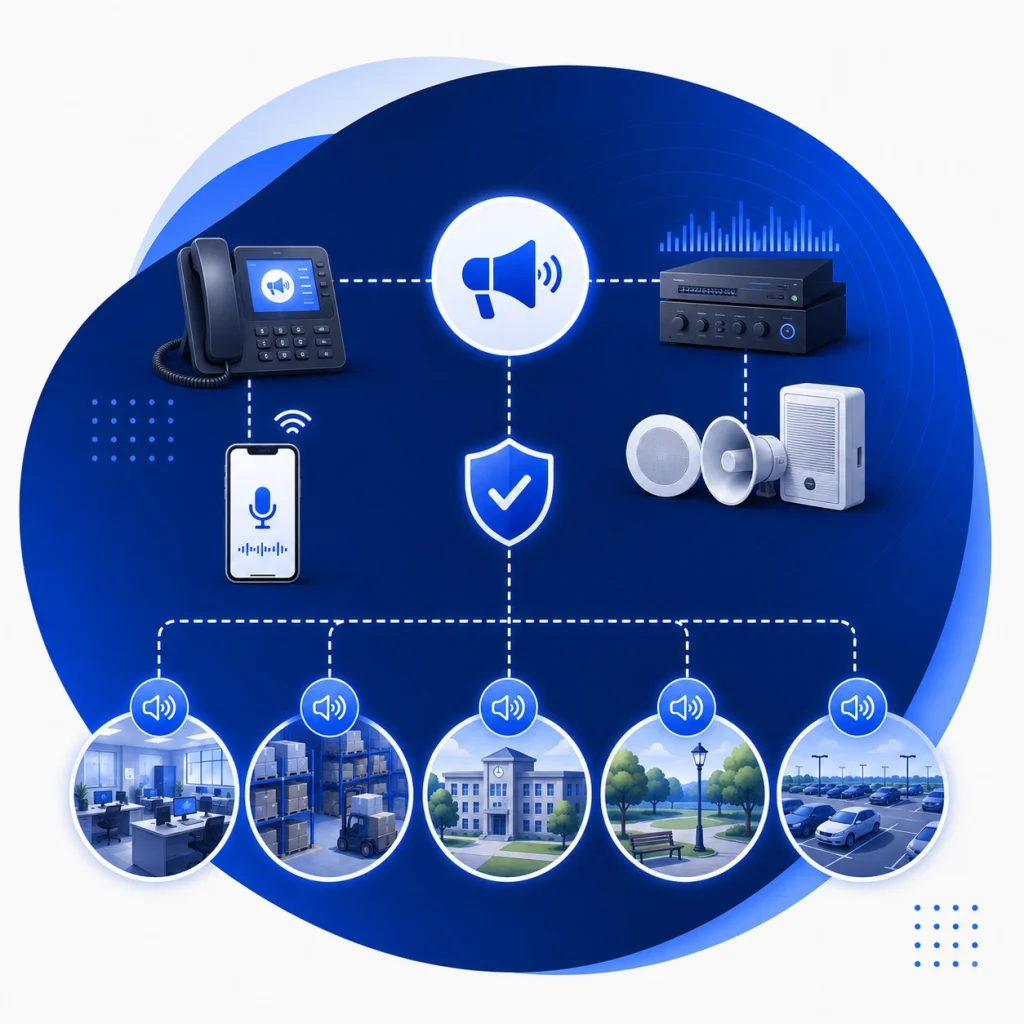
External paging is especially useful for businesses that:
Need to communicate with employees who aren’t always near a phone or computer
Want announcements directed to specific departments or locations
Operate warehouses, manufacturing facilities, schools, campuses, or large offices
Need paging to work alongside an existing business phone system
Have indoor and outdoor areas that need reliable audio coverage
Want one system for everyday announcements, alerts, and other facility communications
Gibson Teldata can assess your building, existing infrastructure, noise levels, and communication needs to design paging coverage around the way your organization operates.
Depending on your environment and selected system, capabilities include:
Send announcements to an individual area, a group of zones, or the entire facility instead of broadcasting every message everywhere.
Use speakers designed around different environments, from offices and classrooms to warehouses, parking lots, and exterior spaces.
Make pages from compatible desk phones, phone systems, microphones, or other authorized devices.
Give urgent announcements priority over routine pages or background audio when supported by the system.
Expand speakers, zones, buildings, and functionality as your facility or communication requirements change.
Communicate with people who may be working away from a desk, carrying equipment, helping customers, or moving throughout a large facility.
Use zones to reach the areas that actually need a message without distracting everyone else.
Create a consistent way to share operational updates, visitor announcements, shift information, and other important messages.
Integrate compatible paging equipment with phone systems, audio distribution, and notification technology to create a more unified communication environment.
Yes. Zone-based systems allow announcements to be directed to specific departments, floors, buildings, outdoor areas, or groups of zones.
In many systems, yes. Paging can often integrate with compatible business phone systems so authorized users can make announcements from a desk phone or other endpoint.
Yes. A properly designed system can use different speaker types and configurations based on the environment, coverage requirements, and surrounding noise.
Potentially. Gibson Teldata reviews your existing speakers, wiring, amplifiers, phone system, and other infrastructure to determine what can be reused and what should be upgraded.
For over 40 years, Gibson Teldata has helped organizations design and support communication technology that works across their entire environment, from the front office to the farthest corner of the facility.

Effective paging and audio start with the space itself. Gibson considers your building layout, coverage areas, noise levels, existing equipment, and communication workflows before recommending a solution.
Paging, audio, phone systems, mass notification, security, networking, and other technologies shouldn't have to operate in isolation. Gibson can help bring compatible systems together.
From speakers and cabling to amplifiers and system programming, our team can help make sure each component is properly designed, installed, and configured.
Get ongoing help from an experienced team that understands both your system and the way your organization uses it.

Create direct communication between entrances, offices, secure areas, classrooms, and other locations with intercom technology designed around your facility.

Connect employees across the office, facility, or multiple locations with cloud, on-premises, and hybrid phone solutions that can integrate with other communication technologies.

Bring communication and safety technology together with solutions designed to help organizations respond, coordinate, and keep people informed when it matters most.