
Table of Contents
Growth often reveals gaps in how organizations handle business communication. What worked for small teams can quickly strain under new demands, higher call volumes, and rising customer expectations.
Missed phone calls, delayed responses, and disconnected communication channels aren’t just inconveniences. They’re signs that existing business communication solutionsand communication infrastructure are no longer aligned with business needs.
For small businesses and growing organizations, this is the moment to reassess business communication solutions.
Modern business communication requires more than basic phone calls. It requires flexible, scalable communication systems, and cloud-based platforms that support teams, customers, and long-term business growth.
What to expect from this guide:
- How to recognize the signs that existing business communication systems are no longer supporting business needs or growth
- What modern business communications should support to improve efficiency, consistency, and customer experience
- How unified communications reduce reliance on multiple communication tools and simplify communication infrastructure
- Why cloud-based communication systems and scalable platforms are critical for future growth
- How a future-proof communication foundation supports consistent service, customer satisfaction, and long-term operational efficiency
How Growth Impacts Business Communication Systems
As companies expand, communication systems are often stretched beyond their original purpose. Business operations become more complex. Teams grow. New users are added. Multiple locations come online. Without the right communication infrastructure, inefficiencies multiply.
Common signs that business communication systems are struggling include:
- Teams relying on multiple communication tools that don’t integrate
- Customer interactions handled differently across departments
- Call routing challenges that affect customer experience
- Remote teams lacking reliable communication platforms
- Difficulty managing teams across locations and devices
These issues are rarely caused by staff or process. They’re usually the result of legacy systems and traditional systems that were never designed for scalability or cloud technology.
What Are Business Communication Systems?
Business communication systems include the tools, platforms, and processes organizations use to connect employees, customers, and partners. These systems boast key features that support phone calls, voice calling, instant messaging, video conferencing, video meetings, team messaging, file sharing, and customer engagement across communication channels.
Modern business communication systems rely on internet protocol and VoIP technology rather than physical phone lines. This shift enables cloud-based systems that are more flexible, easier to manage calls, and better suited for future growth.
A strong communication infrastructure connects people through a single platform, ensuring teams stay connected while data protection, security features, and business continuity remain intact.
The Four Types of Business Communication
Business communication typically falls into four main categories:
- Internal communication between employees and small teams
- External communication with customers and partners
- Operational communication that supports business operations
- Customer-facing communication handled through contact centers
Modern unified communication platforms bring these types together, reducing reliance on multiple communication tools and improving customer satisfaction.
Why Legacy Communication Infrastructure Falls Short
Legacy systems were built for static environments. They depend on physical hardware, fixed locations, and limited flexibility. As businesses add new users, mobile devices, and mobile apps, these systems become expensive and difficult to maintain.
Traditional systems often lack advanced features such as call routing flexibility, video calls, voice assistants, and end-to-end encryption. They also struggle to support remote teams, cloud-based solution deployments, and business continuity planning.
As customer expectations rise, outdated communication infrastructure creates inconsistent service, damages customer relationships, and weakens brand loyalty.
What Modern Business Communication Solutions Should Support
Effective business communication solutions support more than basic connectivity. They are a key factor in customer experience, team productivity, and long-term scalability.
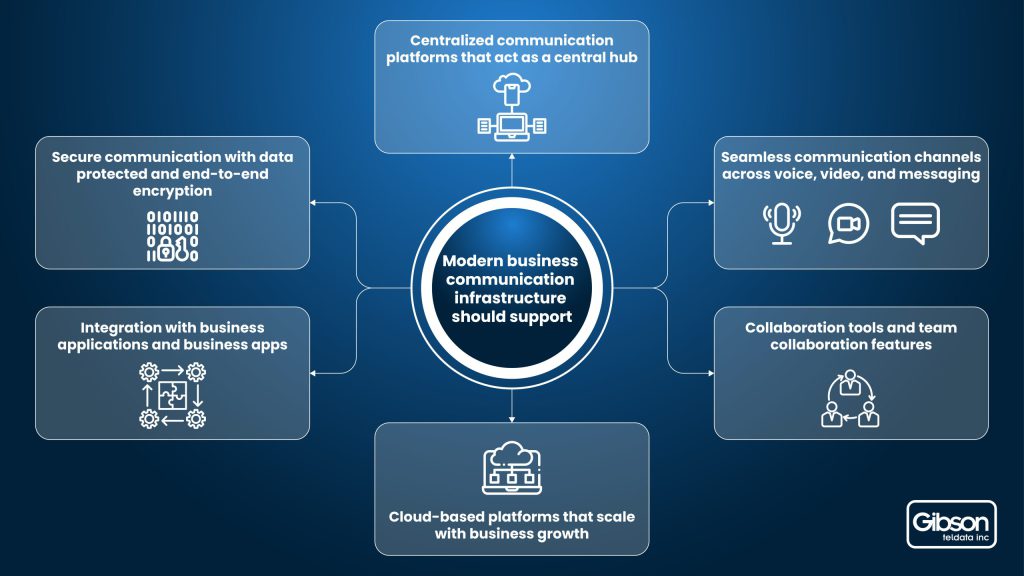
Modern business communication infrastructure should support:
- Centralized communication platforms that act as a central hub
- Seamless communication channels across voice, video, and messaging
- Collaboration tools and team collaboration features
- Cloud-based platforms that scale with business growth
- Integration with business applications and business apps
- Secure communication with data protected and end-to-end encryption
Cloud-based communication solutions empower businesses to adapt quickly while meeting evolving business needs.
Understanding Unified Communications
Unified communications solutions combine voice calling, video conferencing, instant messaging, file sharing, and collaboration tools into a single platform. A unified communications solution replaces fragmented communication tools with integrated communication platforms designed for efficiency.
Unified communications support modern business communication by connecting teams through cloud technology, mobile devices, and desktop systems. This approach, used by over 50 percent of businesses, simplifies managing teams, improves team productivity, and ensures teams stay connected regardless of location.
Unified Communications vs. VoIP Technology
VoIP technology enables voice calls over the internet protocol. Unified communications go further by integrating voice calling with video meetings, team messaging, contact centers, and business applications.
For small and customer-facing businesses, unified communications provide a future-proof communication strategy that supports customer engagement, preferred channels, and consistent service across communication channels.
The Role of Cloud-based Communication Systems
Cloud-based communication systems eliminate the limitations of on-premise hardware. They allow organizations to add new users quickly, support multiple locations, and deploy new communication tools without disruption.
Examples of cloud-based communication include hosted phone systems, cloud-based platforms for video conferencing, and cloud-based solution environments that integrate with Microsoft Teams and Google Workspace.
Cloud-based communication infrastructure supports business continuity, remote teams, and future growth while reducing reliance on traditional systems.

Scalability as a Key Factor in Communication Strategy
Scalability in communication means systems can grow without sacrificing performance. Highly scalable systems allow organizations to:
- Add new users without reconfiguring infrastructure
- Route calls efficiently across departments
- Support small teams and large contact centers
- Maintain customer satisfaction during peak demand
Scalable communication systemsare essential for healthcare providers, growing enterprises, and small businesses planning for future growth.
Improving Customer Experience Through Better Communication
Customer experience is directly tied to how businesses handle communication. Inconsistent call routing, delayed responses, and disconnected communication platforms damage customer relationships.
Modern business communication systems improve customer interactions by:
- Supporting consistent service across teams
- Enabling faster responses through unified communication platforms
- Aligning communication strategy with customer expectations
Stronger communication leads to higher customer satisfaction, improved customer engagement, and increased brand loyalty.
How Unified Communications Empower Businesses
Unified communications empower businesses by simplifying communication infrastructure and reducing complexity. With a single platform, teams manage calls, collaborate efficiently, and adapt to changing business operations.
Advanced features such as video meetings, mobile apps, voice assistants, and security features help businesses stay competitive while remaining future proof.
Cumulus: A Cloud-based Solution for Growing Businesses
Gibson Teldata’s Cumulus hosted phone system is a cloud-based solution designed for small businesses and organizations preparing for future growth. As part of Gibson Teldata’s unified communications offering, Cumulus delivers flexible systems that scale with business needs.
Cumulus supports:
- Cloud-based communication infrastructure
- Call routing across teams
- Support for mobile devices and remote teams
- Integration with communication platforms and business tools
By leveraging cloud technology, Cumulus helps businesses move away from legacy systems while maintaining reliable communication systems.

Building a Future-proof Communication Infrastructure
Future-proof business communication infrastructure is built on flexibility, security, and scalability. Cloud-based platforms, unified communications, and integrated communication systems create a foundation that adapts to business growth.
Organizations that invest in modern business communication solutions position themselves to meet customer expectations, protect data, and support evolving business operations.
Partnering with Gibson Teldata
Gibson Teldata works as a strategic partner, not just a technology provider. The team helps organizations assess business communication systems, design a communication strategy, and implement cloud-based systems that align with long-term goals.
From small teams to complex contact centers, Gibson Teldata delivers communication platforms that empower businesses, support customer experience, and enable sustainable growth.
Preparing for the Next Stage of Business Growth
As organizations grow, communication becomes a critical success factor. Rethinking business communication solutions allows companies to move from reactive fixes to intentional planning.
Unified communications, cloud-based communication solutions, and scalable infrastructure help businesses stay connected, competitive, and future proof.
To learn more about how unified communications can support your organization, explore Gibson Teldata’s approach to business communication solutions and see how Cumulus creates a modern foundation for business communication. Or, just get in touch, we’re always available for you.